



What is a Technological Cosmology?
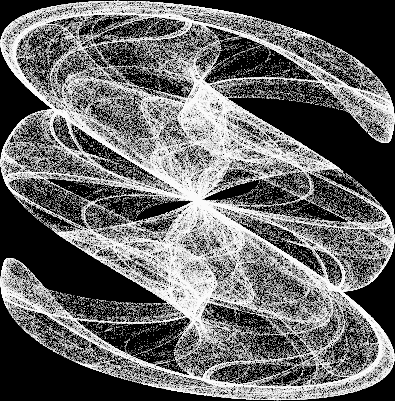
"Generative Sigil" by Joshua Madara
The spread of advanced technology in everyday life has accompanied a retreat of religious language from mainstream culture. Not long ago, religion was more than a means of attaining amoral compass, the source of "values" that it is today. Although it still does take this tendency in certain cultures and circumstances, religion once was, throughout the world, the text of a cosmology that describes the way the world works. Religion was the key to explaining the mysteries of life, and even when its cosmology was proved wrong, its larger cultural weight served as a point of departure for more detailed, scientific discoveries. The motion of the spheres, the aetheric whispers of the electromagnetic spectrum, the heaving and quaking of the ball of matter we live upon--historically, these phenomena were not correctly understood by religious or spiritual explanations, but at least they were a place to start. The Galileos of the world needed a cosmology to refute, if they were going to move closer to what we call truth.
Even today, we rely on a basic, not-exactly-correct cosmology that serves the majority of us well, in trying to comprehend the things we see around us every day. No, an airplane does not really fly using Bernoulli's Principle. Newtonian physics help us understand the flight of a ball, but the reality is that time-space is far more complicated than that. But these explanations work fine for us. They give us a point of departure, a plane of certainty from which we may launch ourselves, if we really want to dig into the depths of scientific exploration.
The structure of the cosmology that we take to be “religious” or “spiritual” has not really changed, only mutated. The details of any particular theology change regularly, as the people in charge of making such decisions alter the details of ritual practice, liturgical text, and other edicts of power-relations. But the general framework of a “realm beyond our standard understanding” remains, especially given the strange wonders of technological advancement. We’ve changed the language, but the goal is still to understand and interact with what we do not understand, by using some time-honored assumptions of how such a spiritual realm might function as a cosmological base..
Consider our replacing of the word “gadget” for “spirit”. The spirit, both an inimical part of the human being as well as an non-human remnant or ethereal being, is hard to grasp and identify, but its presence is irrefutable to most humans’ experience. Gadgets are not part of humanity, and yet they are just as fleeting and haunting, yet supremely real. What defines a gadget? What makes a lump of circuits and interfaces into a gadget? At what point in the construction of a personal electronic device does it become a gadget? When a cell phone breaks and becomes a piece of e-waste, to where does the gadget flee? How do we explain our seemingly irrepressible desire to possess and use gadgets? We never think of our gadgets as human, and yet as humans, we are drawn to them. Our souls have migrated, from our hearts and heads, out the tips of our fingers into touch screens. We seek out the depth of gadget-function as if they were the inconsistencies of the soul, to help us maintain the networks, to be good people in society. We understand gadgets are mini-souls--not the everlasting soul that religious teachings would have us cultivate and maintain, but augmentations of that central soul, that enables and changes the functioning of our core humanity.
And of course, none of this is true. Gadgets are bits of silicon, copper, and rare earth metals. There is no place in the human body for soul, there are only cells and electrochemical differentials. But our gadgets and spirits are part of a cosmology, that helps us deal with the conflicting and complicated reality of our technology and bodies on a daily basis.
We can see this sort of cosmology form even more strongly when our gadgets/spirits comes under stress. Even more resolute than our belief in the positivity of the spirit and gadget, is our hatred and fear of the “bug”, the “gremlin”, which has taken the place of the demon. These interferences upon the good gadgets of the world are, realistically, due to weaknesses in design, or simply the aging nature of the gadget. But we consider them much more vile and malignant. They plague the upright, proper functioning of our technological cosmology. We think they might have been sent by witchcraft, or as we have come to call it, hacking. Or at the very least they are due to the moral failures of those who are supposed to keep our worldview operational and consistent--the leaders and clergy of our technology. Our hatred and fear of these demons surpasses our ability to rationally understand how it works--every cybersecurity operation, to the common understanding, is really an agency of “defense against the dark arts”.
The technological cosmology is not simply divided into two contrary categories of good and evil, however. Luckily, we are avoiding a rehash of certain aspects of the late Christian cosmology that condemned as anathema anyone who meddled with cosmology other than the accepted kings of the realm. The way that we approach technology is much more like an earlier cosmology of magic and the supernatural--in which sorcery and witchcraft must be manipulated by any who can, as they are simply tools for affecting that vast side of the world that would be inaccessible otherwise. We call these sorcerers “hackers”, and we are amazed and enthralled at the techno-tricks they conjure for our amusement and well being. We may not understand the means of their powers, but we do understand that they can use these powers both for bad and for good, and this terrain is a world fraught with dangerous responsibility. Sometimes, we even go so far as to dress our hackers up in masks, that symbolize their power as tricksters and avenging warriors.
Perhaps the best example of the ambiguous nature of our implementation of the techno-magical cosmology is the “miracle”, which we have renamed “glitch”. The New Aesthetic is one way of naming particular glitches (among other phenomena) that we find alarming, beautiful, and powerful. When the technological systems that we do not necessarily understand begin to break down, they emit visible residues of these failures, that can either function positively or negatively, in what could either be a fortuitous or unfortunate way. They are the appearance of angels, the miraculous visions of the invisible gadgets that pull the strings. In the static of the stuck screen, in the momentary blur of a satellite photo, and in the output of the database error, we see instances of the technological divine, in the language of our contemporary cosmology’s design.
But as said, any cosmology is just a base. It is a plateau from which to depart, to get closer to the truth. We might be appropriating a magical worldview in order to understand the technological changes happening to us, but that doesn’t mean that it is here to stay or that it is necessarily beneficial. It is hard to say what Copernican turns await us in the short years ahead.
Posted by:
Share:


